|
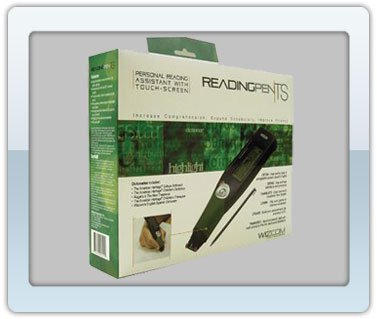
| Research, Articles & Support All ReadingPens the ReadingPen provides teachers and learners with instruction and assistance in the following areas: fluency, vocabulary and reading comprehension, English language learning, management and tracking, assessment, and special education. |
| |
| Below are documented independent research and findings about the ReadingPens. Please note that some of the articles are older and naming conventions and prices that are mentioned are out-of-date. |
| |
| Non profit Organizations |
|
| |
| United States - Colleges / Universities Studies: |
|
| |
| International - College / University Studies |
|
| |
| News Articles: |
|
| |
|
| Non Profit Organizations: |
| |
| Source : The Frostig Center (non-profit organization that specializes in working with children who have learning disabilities), Journal of Special Education Technology (See Paper - PDF) |
| |
Abstract: The study investigated the compensatory effectiveness of the Quicktionary Reading Pen II (the Reading Pen), a portable device with miniaturized optical character recognition and speech synthesis capabilities. Thirty participants with reading disabilities aged 10-18 were trained on the operation of the technology and given two weeks to practice decoding single words and using various dictionary functions during independent silent reading in the classroom and other settings. Participants were then given a reading comprehension test under the following conditions: (a) reading passages silently using the Reading Pen, and (b) reading passages silently without assistance.
Conclusion : Use of the Reading Pen did not appear to create distractions for other students, and very little assistance appeared to be necessary from teachers/aides when the pens were in use. Most students responded well to the technology, with some being quite enthusiastic. Two students related they had ordered a Reading Pen for themselves to use at home as well as at school. Several students were motivated to investigate and experiment with the new vocabulary they were seeing/hearing for the first time and engaged in word play, such as rhyming, breaking words into prefixes, roots and suffixes, and relating the word to semantically and phonologically similar words in various ways.
The study investigated the compensatory effectiveness of the Reading Pen on students with LD (Learning Disabilities), and specifically with reading disabilities. There was significant increases in correct responses to reading comprehension questions. Students not only read the easier selections on the test more accurately, but were able to move on to read more difficult passages with good comprehension. Each selection increased approximately one grade level in difficulty as the child proceeded through each one. On average, the children obtained scores 7 points higher, more than a grade level higher when using the pen. |
| Back to top |
| United States - Colleges / Universities Studies: |
| |
Source : The Graduate Center, The City University of New York See Paper - PDF
Abstract : Six reading disabled students were given an assistive technology (ReadingPens) to see the impact it would have on their reading comprehension.
Conclusion : Students were able to recall and pronounce many of the words they had scanned with the ReadingPen, words which they previously could not pronounce. Students showed great enthusiasm for the tool and the Pen holds promise for schools wanting to integrate technology and comprehension instruction. |
| Back to top |
| .............................................................................................................................................. |
|
Source : Virginia Commonwealth University, School of Education Richmond Virginia; Virginia Adult Learning Resource Center, Virginia Commonwealth University
See Paper - PDF
Abstract : Assistive technology has provided tools for adults with learning difficulties to improve their quality of life, especially in the areas of reading, mathematics and writing. The Quicktionary Reading Pen (QRP) was used by a group of adult students and their tutors to discover its utility in increasing reading decoding and comprehension.
Conclusion : The students mainly used the QRP for spelling and finding definitions of words they did not know. Some students mentioned that it prevented frustration when reading, especially the words they did not know. Those who used the QRP at home (independently) used it to read short stories, books and newspapers. One student used it to read his bills and his mail. Another used it to read a simplified book on the writings of Socrates and Plato.
The QRP has limitations to the size of font it can scan and it takes a little time getting used to it. Despite the criticisms it seems the QRP can make students better readers. One student remarked, �When I am alone I can read more, and I don�t need someone else to read with me.� Another student mentioned that he is helped in the area of spelling. |
| Back to top |
| .............................................................................................................................................. |
|
Source : West Virginia University See Paper - PDF
Abstract : Assistive technology has provided tools for students with learning disabilities to improve their performance in the area of reading. This study investigated how the Quicktionary ReadingPen II (QRP II) affected the reading comprehension levels in science and social studies of a group of twenty eight middle school students who have been diagnosed with a specific learning disability in reading.
Conclusion : The results of this study indicate that across grade level, in both science and social studies the ReadingPen significantly improved comprehension levels as shown by an increase in number of correct answers on given tests. On average, the ReadingPen increased science scores by 18 percentage points and social studies by 10 percentage points. It also showed that for some students it promotes independence and increases confidence levels. |
| Back to top |
| .............................................................................................................................................. |
|
Source : Graduate Student Price Laboratory School, University of Northern Iowa
See Paper - PDF
Abstract : Three students with reading difficulties learned to use the Quicktionary ReadingPen during the initial reading of passages. Their accuracy and fluency of the subsequent reading of the passages was compared to subsequent readings of passages with which the Reading Pen had not been used. The results indicated a consistently greater increase in reading accuracy after the initial use of the Reading Pen, than with repeated reading without the use of the pen.
Conclusion : The results of this study demonstrated that repeated reading with the initial use of the Quicktionary Reading Pen is more effective in reducing the errors and increasing reading accuracy. The errors of three participants decreased in subsequent readings of instructional level passages, when the reading pen was used during the initial reading.The use of the pen with repeated reading does not require constant teacher monitoring, making this an activity that could be benefit students when the teacher is not available to provide direct instruction or monitoring. |
| Back to top |
| International - College / University Studies |
| |
Source : Department Chairman, Eindhoven City College, Netherlands See Paper - PDF
Abstract : Communication in today's world is becoming increasingly more intensive and varied. For dyslexics, who have difficulties with reading, today's reality has not become easier in any way. Fortunately there are also technical developments that benefit dyslexic people. One of the latest tools is a small and handy piece of equipment that is used like a pen and is called the ReadingPen.
Conclusion : Students are no longer dependent upon teachers or remedial teachers if they want to read a text. They can also read anywhere because in contrast to a computer the pen is easy to take along in a coat pocket or school bag. This sense of independence is a tremendous benefit for students who until now have always had to ask for help.
ReadingPen does open a range of possibilities for supplementing RT (Remedial Teaching) to students who - thanks to the ReadingPen -could become more autonomous readers and who could discover that reading is fun. |
| Back to top |
| .............................................................................................................................................. |
|
Source : Hokitika Primary School, New Zealand ( See Paper - PDF )
Abstract : This implementation trial sets out to identify if the Oxford Reading Pen (ORP) is an appropriate and effective compensatory ICT (Information and communication technologies) to assist students with reading difficulties in their classrooms.
The trial seeks to clarify if the ORP can satisfy four key questions: Can the ORP: (1) Be used independently by a student within their classroom? (2) Enable reading comprehension to be enhanced? (3) Increase reading accuracy? (4) Enable students to read for meaning at their chronological age?
Conclusion : The independence the students demonstrated within such a short time using the ORP was astounding. It increases reading accuracy and comprehension for students with low reading ability and three of the students required no further assistance.
The results indicate that the ORP can be used effectively across a range of students ages between 10 and 15 years. The students all had varied levels of skills with ICTs and there are very few pre requisite skills needed to ensure success with the ORP.
It�s cheap price, simple operation and ease of implementation negates many of the problems associated with more bulky, expensive and complex ICTs which require weeks of training and lots of preparation time.
As one student commented �I liked using it� and another added �I would read more� the ORP appears to be an appropriate and effective compensatory ICT which can be recommended for use in schools. |
| Back to top |
| Articles: |
| |
Source : Russellville Newspapers, Inc., Arkansas See Paper - PDF
Abstract : Local businesses and organizations sponsored 25 ReadingPens for a classroom.
Conclusion : The teacher says �his students love using the pens� they are excited about reading and learning with this new tool� the pens have also helped his students with some Spanish and Indian words.
.........................................................................................................................
Source : National Organization on Disability See Paper - PDF
Abstract : An article about college students and professionals who discover the ReadingPen, and provide their experiences and feedback.
Conclusions : A lawyer uses it daily, he said, �It is a great tool for people like myself with learning disabilities...�
A university medieval English teacher who is dyslexic, said, �It has helped me tremendously. I retain more of what I read when I use it. I know my comprehension has increased.�
A college student who has used it for three months says, �I see an improvement in my understanding of the English language and my ability to learn.� |
| Back to top |
|